


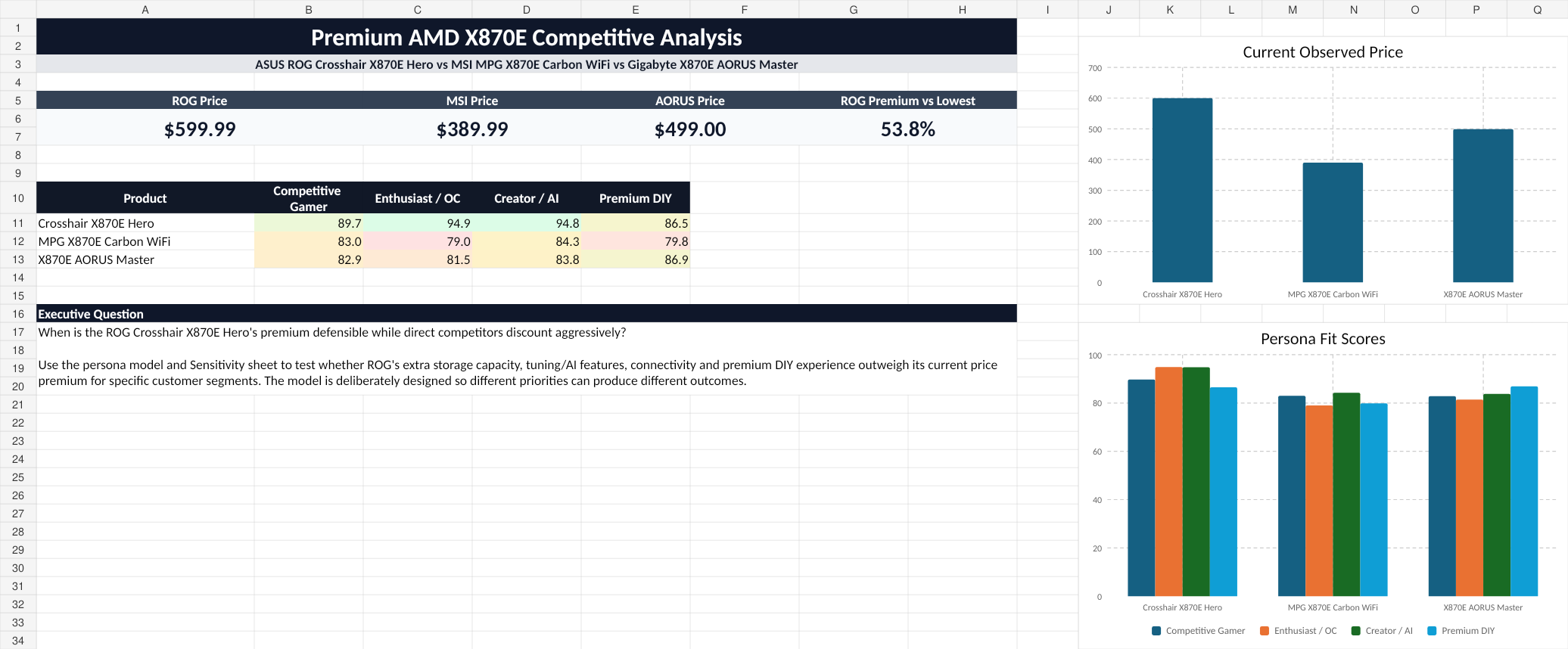
53.8%
ROG premium vs. lowest observed price
Product strategy · Competitive intelligence · Excel model
A decision model comparing ASUS ROG, MSI MPG, and Gigabyte AORUS across product capability, persona fit, and price sensitivity—built to answer when a premium position is genuinely defensible.
01 / Executive summary
The model does not crown a universal winner. It shows where ROG's storage density, connectivity, and tuning stack create specific customer value—and where MSI's promotion or AORUS's DIY execution makes the premium harder to justify.
53.8%
ROG premium vs. lowest observed price
94.9
ROG enthusiast / OC fit score
94.8
ROG creator / AI fit score
0.4
Point gap to AORUS in premium DIY
Business question
When is the ROG Crosshair X870E Hero's premium defensible while direct competitors discount aggressively?
02 / Decision dashboard
The executive view combines observed price, weighted persona fit, and the precise question being tested. Every score can be traced back to the workbook's product data, weights, and source sheet.
03 / Competitive set
The analysis treats positioning as a choice architecture problem—not a spec-sheet race. Each competitor has a credible path to preference.
ASUS ROG
$599.99
Premium platform density
The strongest all-around persona fit in the model, led by five M.2 slots, three Gen5 M.2 slots, dual LAN, and the deepest named tuning / AI feature set.
MSI MPG
$389.99 promo
Aggressive performance value
A credible spec and connectivity package at the lowest observed price, creating the clearest value challenge for price-aware premium buyers.
Gigabyte AORUS
$499.00
Feature-rich premium DIY
The model's premium-DIY leader by a narrow margin, with three Gen5 M.2 slots and the broadest counted set of installation-oriented features.
04 / Key findings
01
Storage capacity, dual networking, and the counted tuning / AI stack reinforce one another for enthusiast and creator workloads. That is a stronger premium story than raw chipset parity.
02
At the observed promotional price, MSI undercuts ROG by $210 while retaining dual LAN, USB4, Wi-Fi 7, and an 18-phase VCORE count. Buyers need a clear reason to step up.
03
AORUS leads Premium DIY 86.9 to 86.5. The gap is small, but it prevents an honest analysis from declaring ROG the winner for every segment.
05 / Persona analysis
Each persona applies a documented 100-point weighting across performance / OC, expansion, connectivity, DIY experience, software / AI, and price / value.
| Persona | Primary priorities | ROG | MSI | AORUS | Model leader |
|---|---|---|---|---|---|
| Competitive gamer | Performance, connectivity, price | 89.7 | 83.0 | 82.9 | ROG |
| Enthusiast / OC | Memory ceiling, power, tuning | 94.9 | 79.0 | 81.5 | ROG |
| Creator / AI developer | Expansion, I/O, storage | 94.8 | 84.3 | 83.8 | ROG |
| Premium DIY builder | Assembly experience, finish, value | 86.5 | 79.8 | 86.9 | AORUS |
06 / Price sensitivity
The sensitivity model holds non-price capability constant, then changes only ROG's price score. This isolates how channel action changes segment fit without pretending the product itself changed.
Observed price ladder
The $389.99 MSI figure was a limited-time official-store observation. All prices were captured September 22, 2026 and should be refreshed before use.
ROG scenario model
A lower price improves the value component; the feature inputs stay fixed.
$599.99
Observed direct price
91.5
$549.99
$50 lower
92.1
$499.99
Matches observed AORUS
92.8
$449.99
Targeted promotion
93.7
The strategic implication is not “discount everything.” It is to use targeted promotions or bundles where the purchase decision is most price-sensitive, while preserving the premium story for enthusiast and creator segments.
07 / GTM recommendation
Position the Hero as the dense, low-compromise platform for enthusiasts and high-I/O creators—not as the default choice for every X870E buyer.
Pair five M.2 slots, three Gen5 slots, dual networking, and tuning automation into use cases. Individual specs are easy to match; the combined workflow is the differentiator.
Use tuning depth for enthusiast channels, storage and connectivity for creator / AI audiences, and the integrated ROG experience for ecosystem-led builders.
Favor retailer bundles, launch windows, or targeted rebates over an undifferentiated permanent price cut that would weaken the premium anchor.
08 / Methodology & sources
This is a positioning model, not a universal quality ranking. Positive product metrics are scored relative to the strongest observed value in this three-board set; price uses an inverse relative-price index.
Source register · captured September 22, 2026
ASUS ROG Crosshair X870E Hero
Official product and pricing page
MSI MPG X870E Carbon WiFi
Official specifications
MSI US Store
Observed promotion source
Gigabyte X870E AORUS Master
Official product and specifications
Newegg
Observed AORUS street-price source
Project artifacts
The workbook is available now. The public methodology repository mirrors the model structure and source discipline; an executive PDF is reserved for the next release.